This Steeped Dive analyzes a dataset of 88,927 English-language AI chats from April 2023 to October 2025. I set out to investigate the perceived overuse of the em dash (“—”) in AI-generated writing, determine whether that perception holds up in the data, and uncover any clues that might explain it.
The dataset source is from this awesome research paper, “A Dataset of Chatbot Conversations in the Wild” by Yueru Yan, Tuc Nguyen, Bo Su, Melissa Lieffers and Thai Le. There were 782,955 messages in English across many platforms (including ChatGPT and Gemini) with ~50% of them being user prompts and ~50% LLM responses. The researchers put it best on why I found the scale of the dataset appealing: “Studying how people actually interact with LLMs in the wild therefore requires large scale, real conversation datasets, rather than only synthetic prompts or short, bench-mark style dialogues.”
After closely examining how the em dash is used today, I am convinced its current prevalence is heavily influenced by AI. Here is the strongest evidence for this:
- 2% of user prompts: In the AI dataset, only 2% of user prompts included an em dash vs 34% of LLM responses.
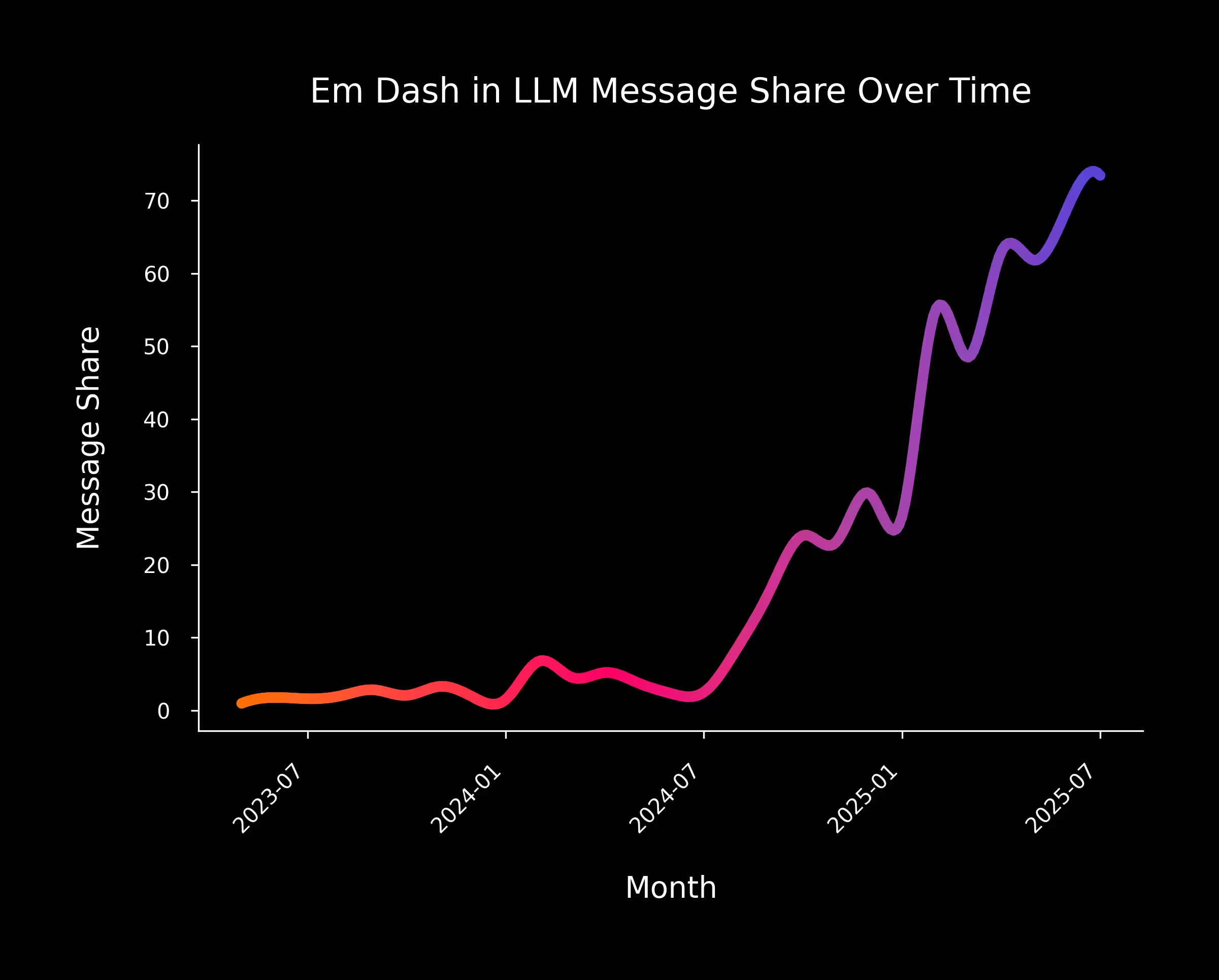
- LLM usage peaked at 73%: In the same AI dataset, the share of LLM messages with “—” rose to a shocking all time high of 73% on 07-2025.
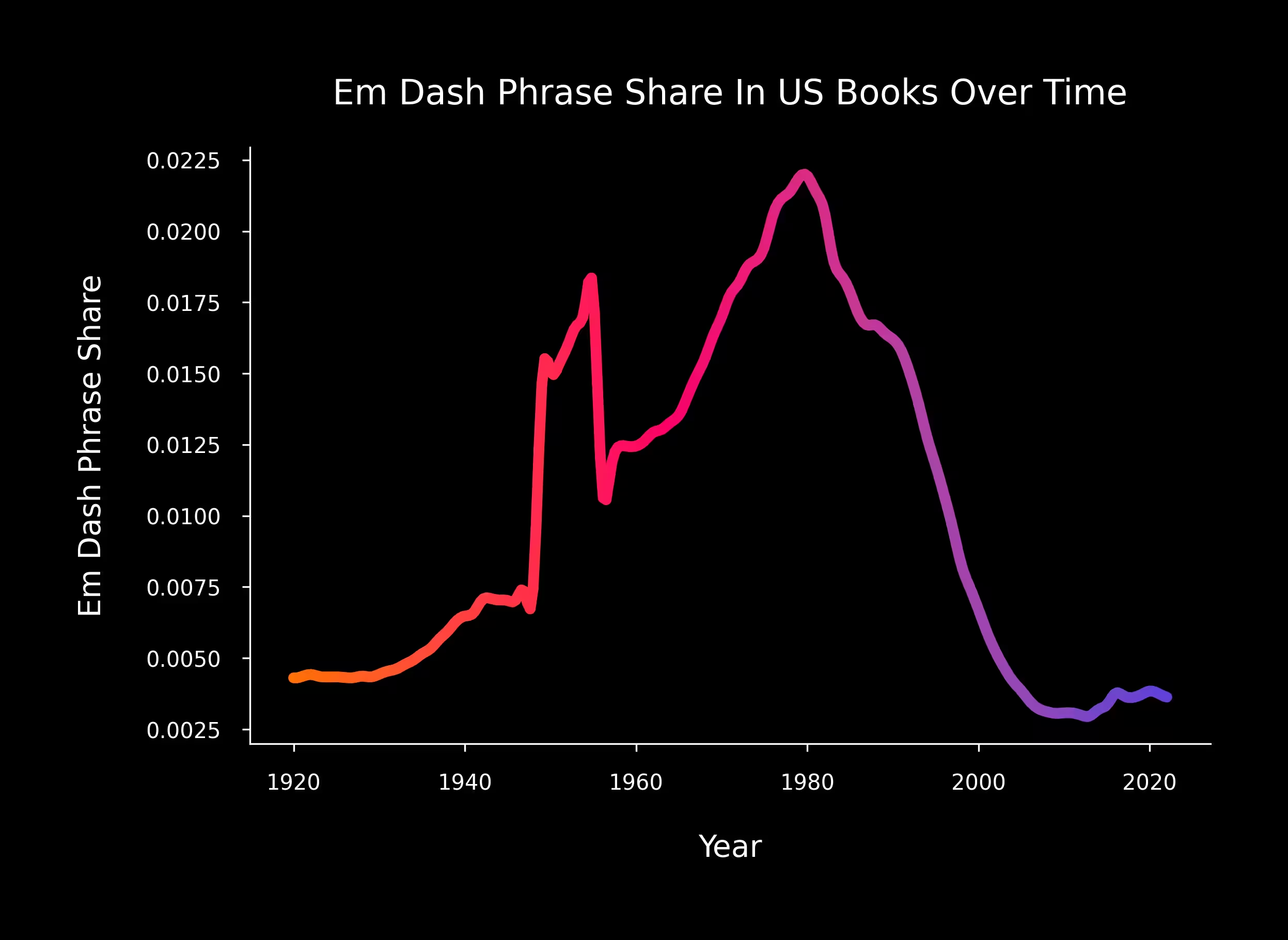
- In books it peaked in 1979: Em dash usage share in U.S.-published books peaked in 1979. Then, between 2006-2022, it declined to levels last seen during the 1800s (US Published Books Google Ngram Viewer 1920-2022).
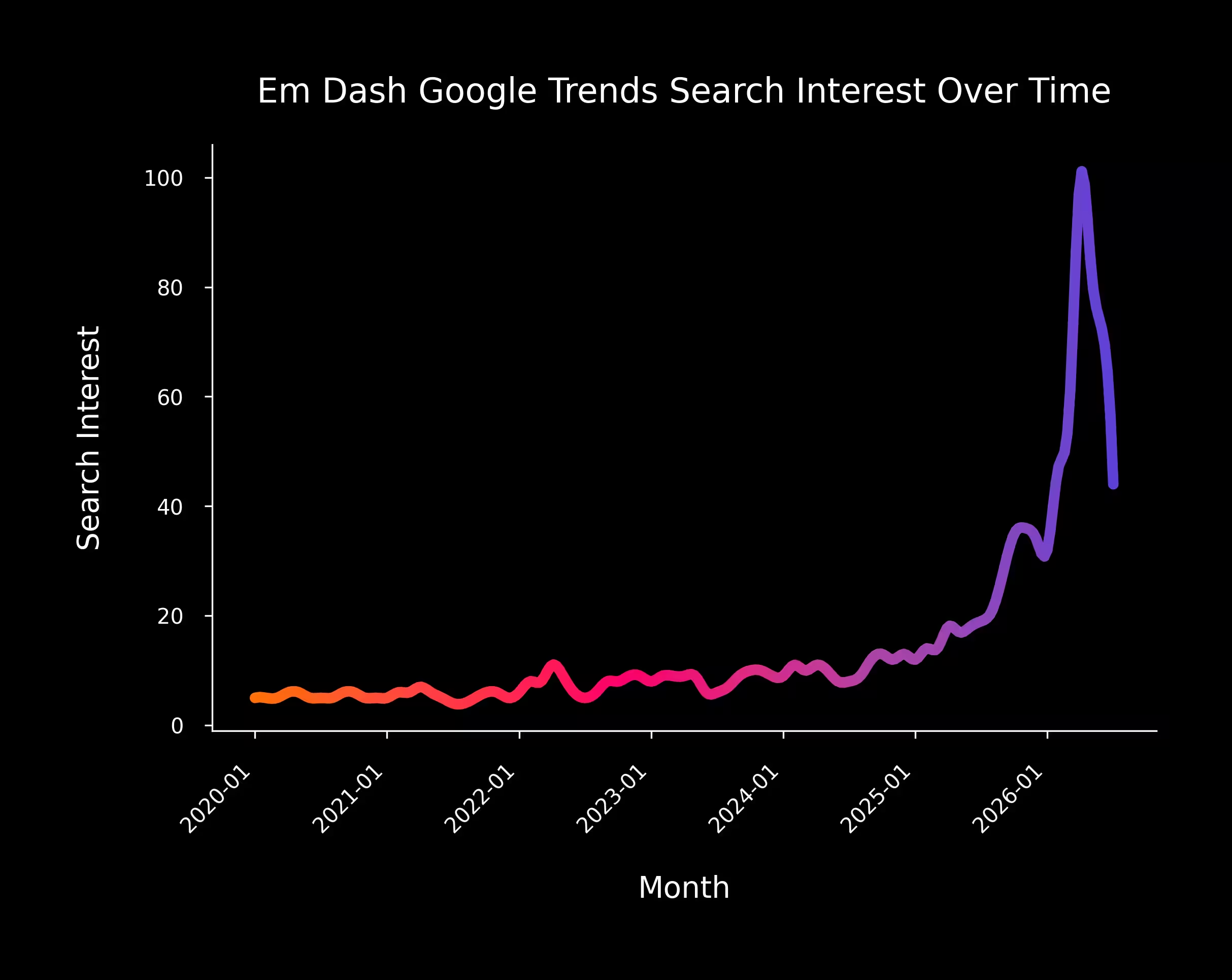
- Massive Google Trends Growth: Within the last year there has been a 245% growth in em dash search interest (August 2025 - July 2026 vs August 2024 - July 2025). There was a 44% 2 year growth in search interest for “—” when adoption started to ramp up in 2023-2024 vs 2021-2022.
How Prevalent Is “—” In AI Chats?
Overall 37% of the AI chats included “—”. This is surprisingly high for a single punctuation mark, especially an em dash, which is optional and stylistic rather than grammatically necessary. If more than 1 in 3 AI chats contains at least one, it isn't a fringe punctuation choice.
Now let’s zoom in from the chat level to the individual messages within those chats, separating user prompts from LLM responses. With a much larger sample of 782,955 messages, the pattern holds: 18% of messages contain an em dash. That’s still remarkably high for an optional, stylistic punctuation mark.
The difference between users and LLMs is even more striking. Just 2% of user prompts contained an em dash, compared with 34% of LLM responses. That 17× difference strongly suggests that the prevalence of the em dash in AI chats is driven primarily by the LLMs themselves, rather than by users bringing the punctuation into their prompts.
Below are examples of user prompts containing an em dash. One appears to have been copied and pasted from other sources, potentially including other LLM-generated text. This is worth noting because user prompts aren't necessarily representative of how people naturally type.
- "it doesn't wake into itself — it just starts fresh (unless it was programmed to save and rehydrate its state)." I'm thinking that it does wake itself into itself.. It's just like a bulb, when it's turned off, nothing happens.
- describe me based on all our chats — make it catchy!
- Okay, onto human visual acuity now.what is the mega megapixel size — so to speak— of normal human vision in noon, bright daylight?
"—" Use Over Time
This chart below shows the monthly share of LLM responses containing at least one em dash (“—”). Usage began rising in August 2024, when 8.5% of LLM responses contained an em dash. This was around the time of ChatGPT-4o mini’s release. From there, usage continued to climb, eventually reaching a shocking all-time high of 73% in July 2025.
To avoid drawing conclusions from months with relatively small samples, several months at the beginning and end of the dataset were excluded because they contained fewer than 1,000 LLM messages.
According to Google Ngram Viewer data for US published books, em dash usage peaked in 1979 before experiencing a steep, decades-long decline. By the 2006-2022 period, its frequency had plummeted to levels not seen since the 1800s.
This chart below shows Google search interest for the em dash (“—”) since 2020, based on Google Trends data. Interestingly, search interest shows the same slight rise around August 2024 that appeared in the AI dataset above.
A much larger increase began in August 2025, around the launch of GPT-5. Search interest then declined beginning in November before surging again in January 2026. That second rise coincided with several major model releases, including OpenAI’s GPT-5.3-Codex, Anthropic’s Claude Opus 4.6, and Google’s Gemini 3.1 Pro in February 2026. Search interest ultimately reached an all-time high in April 2026 before declining rapidly.
Unlike the previous dataset, this measures people searching Google for the em dash, not AI-generated text. It therefore reflects broader human interest in or use of punctuation rather than chatbot behavior directly. Still, the parallel trends are intriguing, and one possible explanation is the growing amount of AI-generated content being published online, where people may encounter and subsequently search for the punctuation.
It’s worth mentioning that the em dash usage of the Google Ngram Book data and Google Trends data had the same camel looking trend line where there’s one small hump followed by an extremely steep spike and drop. Is this indicative of how the em dash typically goes in and out of style? Fascinating discovery.
Theories Why AI Loves the Em Dash
Let's first look at the theories already out there
- An interesting 2026 explanation from Florida International University makes essentially this argument: models learn patterns from training material, and highly regarded writing contains em dashes. The result is that the model can associate constructions containing em dashes with desirable, polished prose.
- The Washington Post similarly reported that OpenAI attributes stylistic patterns such as punctuation preferences to training data and user influence, rather than an explicit rule telling ChatGPT to use em dashes.
And here's my theory related to tokens! There may be another, much simpler explanation for the em dash’s popularity: cost. Specifically, token cost.
- For LLMs, text is broken into tokens, and users are often charged based on the number of tokens processed. In some tokenizers, including tokenization schemes used by ChatGPT, “hello—world” consistently requires one fewer token than “hello — world.” The em dash therefore has an unusual property: it can create strong visual separation without requiring spaces around it, potentially reducing the number of tokens needed to represent the same text.
- In other words, the em dash can give an LLM the visual effect of a highly distinct separator without the token cost of surrounding spaces.
Here's my proof! First let's go back to the AI Dataset:
When we split the LLM messages into individual sentences, the pattern becomes even clearer. Across 452,287 LLM-generated sentences, 69% used an em dash surrounded by words on both sides, rather than spaces, or used a combination of the two patterns. That’s a substantial majority.
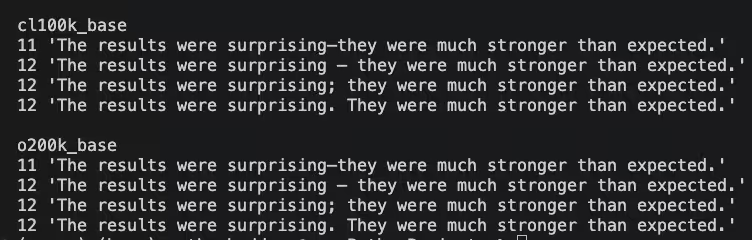
Second bit of proof was my own investigation on python. I used OpenAI’s o200k_base and cl100k_base byte pair encoding tokenizers on python and tested the same (wishful) sentence using various punctuation.
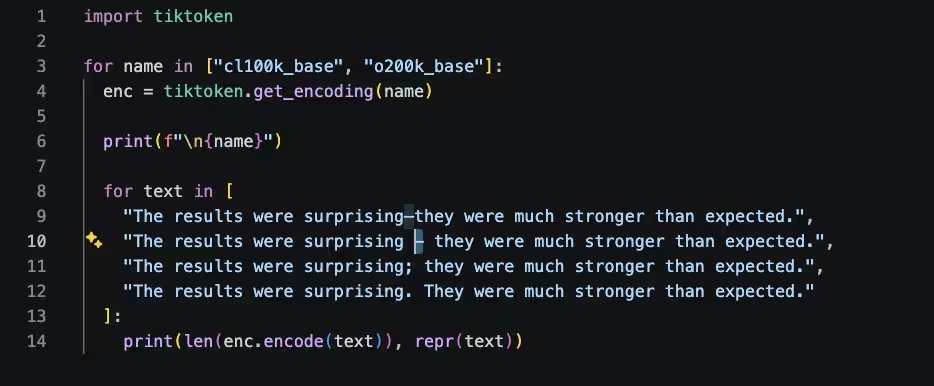
Sure enough! The sentence with “surprising—they” used one less token than the rest including “surprising — they” on both tokenizers and I tested it multiple times.
Looking at the phrases immediately before and after the em dash reveals another interesting pattern. LLMs frequently use the em dash after phrases associated with affirmation and conversational agreement: such as “you’re absolutely right,” “great question,” and “thank you”, or after phrases that acknowledge and clarify the user’s point, such as “got it,” “so yes,” and “so yeah.”
On the other side of the em dash, the pattern shifts. LLMs often use it to introduce an explanation (“it is a,” “this is a”) or an example (“such as the,” “or at least”). In other words, the em dash appears to function as a kind of conversational pivot: affirm or acknowledge the user, then launch into an explanation, qualification, or example.
Further Em Dash Sentence Context
Looking at the number of em dashes per sentence, LLMs generally keep it to a single dash. Across the 452,287 sentences containing an em dash, the average was 1.24 em dashes per sentence, while 82% contained exactly one.
Then there’s the comparison with other punctuation marks. Em dashes appeared in 7% of LLM-generated sentences, compared with just 1% of user sentences. This is another substantial gap that reinforces how disproportionately common the em dash is in LLM writing.
By comparison, hyphens, equal signs, and semicolons showed much smaller differences between LLM and user sentences.
One unexpected finding was the difference in comma usage: 54% of LLM sentences contained a comma, compared with 37% of user sentences. So it seems the em dash isn’t the only punctuation mark LLMs might be particularly fond of. Perhaps that’s the subject of my next article :D
Finally, there’s sentence length. LLMs use fewer words per sentence when an em dash is present than users do. This adds another piece of evidence to the idea that LLMs may be using the em dash as a compact way to pack more context into fewer tokens.